

PSIP
Psychedelic Somatic Interactional Psychotherapy
A body based, relational approach to trauma that works with the nervous system's own capacity to heal.
Some of what we carry was never stored as a story. It lives in the body as tension, numbness, vigilance, or a shutting down that arrives before any thought does. Understanding it helps, but often it doesn't change how the body responds. Many people come to this work after years of insight, still feeling the same grip in the chest, the same freeze in conflict, the same distance from their own feelings.
Psychedelic Somatic Interactional Psychotherapy (PSIP) is a cutting edge approach designed for exactly this layer. Rather than working mainly through insight or retelling, PSIP works bottom up, with the autonomic nervous system and with the relationship between us, so that old survival responses can finally move toward completion.
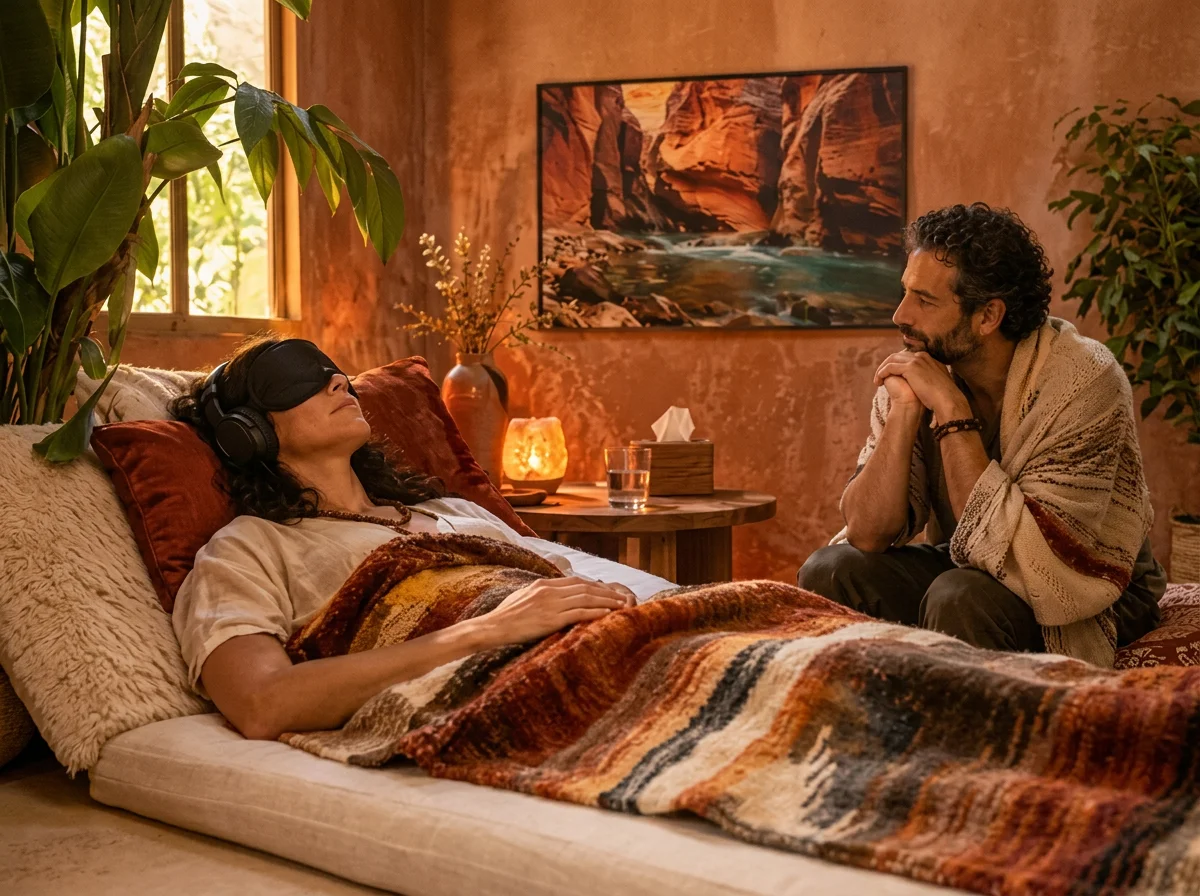
At its heart is a simple idea: when the managing, protective mind softens, a deeper intelligence in the body knows how to move toward resolution. My role is to help create the safety, pacing and relational presence that let that happen. Unlike approaches where a guide sits quietly while you go inward alone, PSIP is interactive. We stay in contact, and what unfolds between us becomes part of the healing.
PSIP was developed through the Psychedelic Somatic Institute. It was designed with non ordinary states in mind, but it does not depend on medicine. The relationship and your own nervous system are the core of the work.
-
PSIP is a body based, relationally engaged approach to trauma. Three threads run through it.
Nervous system first. The work engages the autonomic nervous system directly, the part of us that moves into alertness, fight or flight, collapse or numbness when something is too much.
Primary consciousness. Beneath our verbal, problem solving mind is an older layer of experience made of sensation, emotion, image and implicit memory. This is where much of our relational programming lives, and where PSIP does its work.
The relationship. Wounds that formed in relationship need relationship to heal. In PSIP I am an active, attuned presence, not a silent observer.
-
After a threat, the body is built to return to a settled baseline. When that return is interrupted, especially early in life or again and again, the body keeps holding the charge. Over time it can show up as anxiety, numbness, depression, hypervigilance or a feeling of being stuck.
In a session we slow down and attend to what your body is doing in real time. Together we notice the small, habitual ways we move away from difficult sensation, such as distracting ourselves, changing the subject, or breathing it away, and gently set them aside. This makes room for what the body is ready to express on its own: a tightening, a shift in breath, an impulse to pull back, a wave of emotion. These responses tend to rise, peak and settle in waves. I don't steer what emerges. I help keep the conditions steady enough for your system to do what it already knows how to do.
PSIP also works with numbness and dissociation rather than around them. The places that feel blank or far away often hold what has been most protected, and we approach them slowly, in relationship, at a pace your system can hold.
Because many of our deepest wounds are relational, what happens between us is part of the work too. Old patterns, like bracing for judgment or wanting to disappear, can show up in the room, where they can be met differently this time.
-
PSIP is not primarily about insight, reframing or telling the story of what happened. Talking still has a place, especially in preparation and integration, but the change itself happens at the level of the body.
This means you don't need to remember or name a trauma in order to work with it. Much of what shapes us was stored as implicit, body based memory before we had words for it, and the nervous system can work with that material directly.
-
Every course of work is different, but it usually moves through these phases.
Preparation and resourcing. We get to know your history, your patterns and what your system needs to feel safe enough. We build resources you can return to when things become intense.
PSIP sessions without medicine. We begin working directly with the nervous system, often starting with a more contained, less charged experience so we can learn how your system responds and what it needs. Sessions are often longer than a standard hour, to allow time to settle in, process and close.
Integration. We make sense of what moved, tend to how it is living in your body now, and bring what was meaningful into daily life and relationships.
Ongoing work. Experience tends to be layered, so the work usually unfolds over a series of sessions rather than all at once.
Medicine-supported PSIP, using low doses of legally prescribed medicine with a prescribing physician, may be offered in the future. Medicine is always optional.
-
PSIP may be a good fit if you:
Understand your patterns but feel talk therapy hasn't changed how your body responds
Carry developmental or complex trauma, including CPTSD
Notice numbness, dissociation or shutting down that hasn't cleared
Live with chronic hypervigilance, anxiety or a sense of being stuck
Find early relational wounds showing up again in your closest relationships
Are curious about non ordinary states but want a relational, body based foundation first
PSIP can be intense, and progress is rarely linear. It may not be the right fit if you are in acute crisis, have a history of psychosis, or don't currently have enough stability and support outside of sessions. We talk this through together, and if PSIP isn't the right fit, I'll help you find what is.
-
PSIP sits naturally alongside the rest of my work. Hakomi's mindfulness helps us slow down enough to notice what the body is doing. IFS helps us meet, with curiosity, the protective parts that show up when things get close. NARM keeps us oriented toward connection, agency and what is possible now.
I begin without medicine because the foundation matters. Enough safety, trust and capacity in your system comes first, so that whatever moves has somewhere to land.
My approach is shaped by more than fifteen years of somatic bodywork and more than twenty years of study and experience with expanded states and healing traditions. I go at the pace of your system, with consent at every step. I'm not here to push anything open. I'm here to help create the conditions where what is ready can move.
-
In PSIP, integration is part of every phase, not something added at the end. Between and after sessions we make room for what has shifted: new sensations, emotions, memories, or a different way of being in relationship. We may draw on reflection, somatic awareness, parts work, and practices like journaling, meditation, breathwork and creative expression.
If you are looking for support making sense of an expanded state experience that happened elsewhere, recent or long ago, see Psychedelic Integration on the Somatic Psychotherapy page, or Integration Support on the Coaching / Mentorship page.
-
Do I need to take medicine?
No. PSIP works with the relationship and your own nervous system. Medicine-supported sessions may be offered in the future, and medicine is always optional.
Do I need to remember my trauma?
No. Much of what the body holds was never stored as a clear memory. PSIP works with what your system is carrying now, whether or not it comes with a story.
How long are sessions?
Usually longer than a standard hour, to allow time to settle in, process and close. We talk through length and frequency on the discovery call.
How many sessions will I need?
It depends on what you are carrying. A single event with a fairly stable early life often needs fewer sessions. Complex or early relational trauma usually needs more, and the work tends to unfold in layers.
How is PSIP different from other psychedelic therapy?
Many approaches use eyeshades, music and a mostly quiet guide, with most of the meaning making happening afterward. PSIP is interactive. The work happens in real time, in the body and in the relationship.
Is PSIP right for me?
The best way to find out is a conversation. On a free discovery call we can talk about what you are carrying and whether PSIP fits.
If you are in crisis or thinking about harming yourself, call or text 988 or go to your nearest emergency room. This site is not monitored for emergencies.
"Human relational wounding requires human relational healing."
—Psychedelic Somatic Institute
"Trauma is not what happens to us, but what we hold inside in the absence of an empathetic witness."
—Peter A. Levine